Showing posts with label innovation. Show all posts

Saturday, September 6, 2008

2 Weeks in the ThinkBalm Innovation Community

For the last 2 weeks, I have actively participated in ThinkBalm's Innovation Community. For those of you who haven't heard of this new community, here are my impressions:

What is it:

In a nutshell, it's an online approach to inovation management. Built on the Spigit's serious game platform (see my earlier post explaining Spigit), ThinkBalm's community focuses on generating and critiquing ideas relating to the immersive internet. The ideas are refined through community member interaction and feedback.

How it works:

Take a brainstorming session, mix in equal parts of Wall Street, facebook, your favorite blogs,

market economics, election politics, LinkedIn, and academic peer reviewed journals, hit purée, and you start to get a feel for what it is and how it operates. Members have a range of methods to engage in the process, but it all starts with someone posting their idea.

The idea founder's goal is to progress their idea through a standard process of peer review hurtles, structured much like a business startup, with a hopefully successful IPO and strong market capitalization on the game's "spock" market. Based on peer feedback, founders can refine their ideas and, if necessary, even recruit partners with "spock" ownership incentives. Members provide feedback through discussion forums, by writing reviews, and by voting to "spig" or "scrap" the idea. Your can choose to change your vote if compelling evidence is presented in discussion or if the idea's team improves the idea. You can also spig and scrap discussion comments, which not only voices you opinion of the comment but also impacts the reputation of the member that posted the comment.
The Performance Feedback:

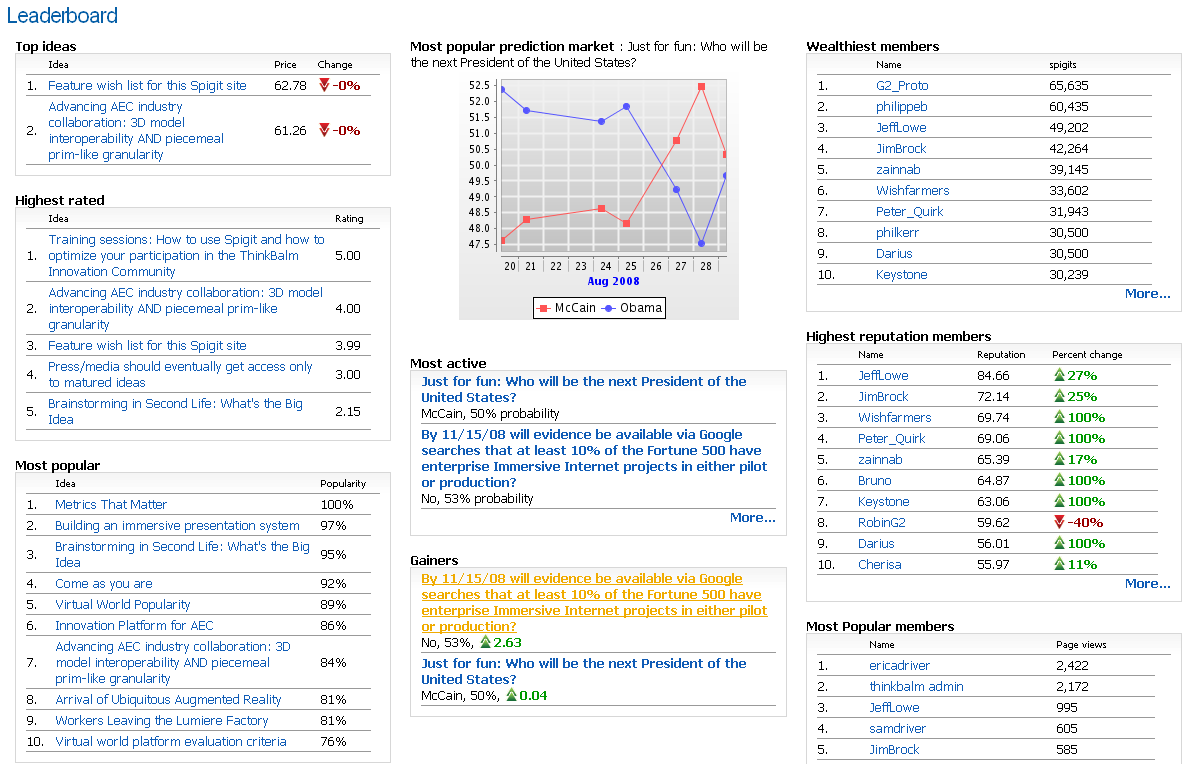
The variety of performance feedback provided quickly draws you into the community's "game" of innovation. The leaderboard gives the low-down on member and idea performance, ranking both on reputation, popularity, and wealth. It's a thrill seeing your ideas and your name rise and fall through the rankings.
So, why you should pay attention:

It's practical...

Sure, there is some pie-in-the-sky prognosticating (like one of my my ideas: Arrival of Ubiquitous Augmented Reality), but the collective wisdom of the vigorous community discussion always keeps the proverbial one foot on the ground. I have discovered it is a great way to improve the ideas you've developed, as long as you are willing to listen and adapt.

Stay on the cutting edge of innovative virtual environment thinking...

If you are interested or involved in virtual environments, whether it be for education or the enterprise, the community is an excellent source of innovative cutting-edge thinking.

Games are the future of work...

I'm very impressed with the way this "game" approaches the process of innovation. It's not a top-down, let's-meet-to-discuss-ways-our-organization-can-step-out-of-the-box, typical enterprise approach to promoting innovative thought and action. It's a fun, grass-roots, games approach to gathering innovations from the workforce, which is often the source of the most significant innovations.

It's fun...

Even after a long day of work, I still enjoy logging on and contributing my thoughts. It's just plain fun. And any tool an organization can deploy that taps into the heart of their stakeholders has enoromous potential.

Saturday, July 12, 2008

Tools of the Trade: Spigit's innovation management applications

Most organizations are incredibly inefficient at utilizing the collective creativity and knowledge of their employees and customers.

Juxtapose the dynamics of organizational relationships with social relationships outside the workforce. Facebook, LinkedIn, Skype, Second Life or any number of socially enabling technologies help us not only stay connected, but enhance our ability to share experience and thought.

Spigit applys these social concepts to the workforce. Their enterprise software IdeaSpigit & InnovationSpigit allow workers and customers to not only easily share ideas & concepts, but to also evaluate, contribute, and rank the contributions collaboratively. Those that make positive contributions gain in reputation, effectively increasing their workplace social capital. Effectively deployed, I can see how this would move brainstorming and innovative thinking away from meeting-centered to a daily routine (and who wouldn't want a workforce that constantly thinks innovatively).

Props to Erica Driver of ThinkBalm for pointing me towards this fascinating suite of applications.

Thursday, June 26, 2008

Tools of the Trade: Jott.com


"Who would you like to jott?"

Jott.com is a thus far free service that converts your short phone messages into text, then sends that text to any of your pre-established contacts. I primarily use it to take quick notes or set reminders for myself while I'm on the go. I also have a setting to automatically post messages onto this blog and a setting to text my wife. There are a multitude of applications...imagination is your limit.

Most recently, I've set up a system that will allow me to easily track my mileage for work. When I get to the location, I simply look at the odometer, and state the mileage in a jott message to myself. When my outlook receives the jott message about mileage, it auto transfers it to the mileage folder. Then, at the end of the month I can easily process all the mileage claims.

I've been impressed with the accuracy of the voice-to-text conversions, although I do keep the messages brief and simple. It sometimes converts "too" as "2" and vice versa. On difficult words, it allows you to say the word, then spell it out (eg "watt... However, the converted text in such an instance only displays the word, "watt."

Happy Jottin!

Saturday, March 1, 2008

Today on Tomorrow: Orchestrating Information in 3D


We are stuck in the past, in an antiquated paradigm. We are sipping through a tiny coffee stirring straw while we remain parched. We require a new information processing model for individuals, one with the ability to match the ever increasing levels of available information produced by our world.

We google search, read feeds, watch TV News, browse websites, read and write blogs, store bookmarks to sites, scratch notes onto paper, daydream while commuting, read/write/reply/forward emails, stuff thumbdrives, get managed by planners, cram papers into binders, interact over the phone, IM statements, attend meetings, record meetings, set more meetings, (did I mention meetings?), read & write books, have truly brilliant ponderings that evaporate in an instant before recording, wandering wikis, absorb excel spreadsheets, record/revise/file way word documents, solidify filing cabinets, hear podcasts, watch vodcasts, and so on. And while we do, all too often brilliant innovations vanish before birth due to the lack of the individual's ability to weave the disparate multi-disciplinary bits of information into a cohesive meaningful construct of knowledge. And not only that, even if and when we do achieve some semblance of a construct of understanding, new information always arrives to erode or eradicate the order.

Information orchestration models and tools of the future will empower individuals to navigate the oceans of information, assimilate useful streams of information, organize these streams into rapidly understood and useful forms, process these forms into useful and timely knowledge. Whatever these models will be, they will undoubtedly utilize more of our bodily senses in an effort to optimize the transaction (improve efficiency of throughput) between the human individual and the tool.

Imagine in the future immersing yourself into your Personal Knowledge Garden, a virtual 3D space containing spacially arranged plants. These plants are repositories of compiled and purposfully sorted information, varying in topic with each different species. Each plant in your garden is of different sizes, shapes, colors, feels, and smells. These differences are not merely cosmetic...the differences represent changes in a certain topic of interest. Grasping one flower, you are instantly exposed to a graphical summary of not the contents, but the changes, the growth of emphasis on one aspect of the topic (i.e. a flurry of information in the world relating to this topic). Further examination of the grown flower petal allows you to see the source information contributions to the plant. A graphical immersive representation of massive amounts of information like this garden would allow humans to utilize their full senses to more efficiently translate massive information into useable knowledge.

Sunday, February 24, 2008

Tools of the Trade: Ajaxlife.net

Problem: Got a work computer, or a laptop, that doesn't have the graphics muscles to run Second Life? Do you need to chat with your contacts/friends in Second Life, but don't really need to eat up processor time?

Possible Solution: Ajaxlife.net

My Observations: Accessing Second Life (an Multiple User Virtual Environment) normally requires downloaded software. To experience the world in all it's 3D glory, you do need a somewhat beefy graphics-capable computer system...something I do not have in my work office. Enter from stage right Ajaxlife. Ajaxlife is a web based interface for Second Life. You don't get all the pretty pictures, or get to move around, or voice talk, or even see anything for that matter. What you do get is this:

Access To

  • Your inventory (and the ability to sort)
  • Avatar profiles (and thus the ability to contact them)

Search Capabilities
  • You can find non-friend Avatars

Communications
  • Local Chat (Text chatting with avatars located near you in the Second Life sim world)
  • Instant Messaging (think of it as a person-to-person text chat)

Tools
  • Scan for nearby Avatars (since you are blind, comes in real handy)
  • Stats (tells you when there is serious lag in world)

Travel
  • Ability to TP to another location via the map

Bottomline:
Incredibly useful tool for those needing access to the communication features of Second Life when they are away from a graphics-capable machine. It is very difficult to Teleport to another location, since you are as blind as a bat (my apologies to all the bats out there), which may prevent widespread use. No download required! Fairly simple to use (EXCEPT for traveling).

...and btw...this was developed by a teenage girl!

Tuesday, February 12, 2008

Goodbye Policy Handbook, Hello Policy Wiki

For the most part, I work at a place that is fairly innovative. We do things that often require us to re-write the policy and procedures book to allow us to provide a particular solution to our clients. But even so, we are still tethered to the standard linear, paginated, print-it-cause-we'll-eventually-have-to-read-it policy book format. I suggested to a like-minded digitally-adept coworker the other day that we should scrap the book and use an internal wiki.

Well, I just finished transforming one policy handbook into a wiki. I used the EXTREMELY SIMPLE (and totally free) tiddlywiki . Basically, I copied and pasted the various segments from the handbook into the html-based wiki, then added all the tags. Now for the big sell at tomorrow's staff meeting. I hope that by providing them an example of the handbook in wiki form with some basic instructions, they will see the potential.